
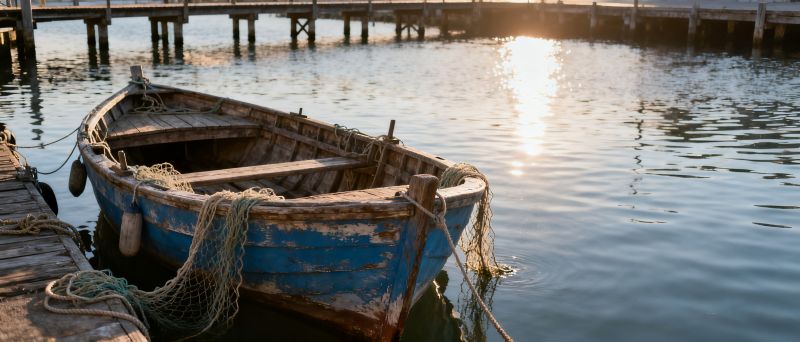
Barcos have always fascinated me. Not just as vessels。but as living pieces of history. Last summer, I spent an afternoon at a small harbor in Portugal, watching fishermen unload their catch from a weathered barca—a wooden boat that had clearly seen decades of salt and sun. The hull was patched in three places, the paint faded to a pale blue, yet it moved with a quiet dignity. That moment crystallized something: these vessels are not mere objects;
they are the physical embodiment of human resilience and adaptation.The design of barcos has evolved remarkably over centuries. Take the Portuguese barca, for instance—its high bow and rounded stern are not arbitrary choices. They emerged from the practical need to navigate rough Atlantic waters while carrying heavy loads of fish or cargo. I once spoke with a shipwright in Aveiro who explained that each curve in a traditional barca has a purpose, often refined through generations of trial and error. Modern fiberglass boats may be faster and cheaper, but they lack that accumulated wisdom. It's a trade-off we don't always acknowledge.Cultural identity is another dimension. In many coastal communities, barcos serve as more than transportation;they are symbols. The Venetian gondola is an extreme case—a barco so iconic that it has become a cliché. But even the humble rowboat in a Scottish loch carries stories. I remember a conversation with an old sailor in Galicia who insisted that the local barcos were “the last honest things left” He meant it. These boats don't pretend to be anything other than what they are—tools for survival, shaped by the sea itself.There's a practical side worth considering, too. Barcos remain essential for artisanal fishing in many parts of the world. According to a 2022 report by the Food and Agriculture Organization, small-scale fisheries using traditional vessels like barcos employ over 90% of the sector's workforce globally. That's not nostalgia;it's economics. I've seen firsthand how a single barco can support a family for years, provided the wood is maintained and the engine (if there is one) doesn't fail. The knowledge required to build and repair these boats is at risk。though. Fewer young people are learning the trade.Perhaps that's why I keep returning to barcos. They are a reminder that efficiency isn't everything. A well-built barco is slow, sometimes stubborn, and utterly dependent on weather and tide. Yet it endures. In a world obsessed with speed and scale。
there's value in that stubbornness. The next time you see a small boat bobbing in a harbor, look closer. It might be a barco—and it might have more to teach us than we think.